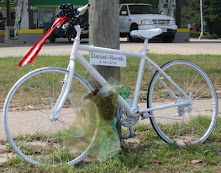
Last SSDD was in 2010

Please visit www.SDCC.info, the Shore Drive Community Coalition website.

SSDD2010 July 17th

Thanks to everyone who participated.

With your help, we've made sharing Shore Drive a little safer.

+ blog starts below +

5.03.2010

"A pedestrian hit at 64.4 km/h (40 mi/h) has an 85 percent chance of being killed; at 48.3 km/h (30 mi/h), the likelihood goes down to 45 percent..."

Some data on pedestrian deaths in urban areas from PedSafe, A Federal Highway Administration program:
Pedestrian crashes occur most frequently in urban areas where pedestrian activity and traffic volumes are greater compared to rural areas...

In recent years, an emphasis has been placed on improving the design criteria used by engineers to ensure that the needs of all users are being met; the Highway Design Handbook for Older Drivers and Pedestrians is one resource...

Speeding is a major contributing factor in crashes of all types. In 2003, speeding was a contributing factor in 31 percent of all fatal crashes. one resource

From the Insurance Institute for Highway Safety:
Speed influences the risk of crashes and crash injuries in three basic ways:

* It increases the distance a vehicle travels from the time a driver detects an emergency to the time the driver reacts.
* It increases the distance needed to stop a vehicle once an emergency is perceived.
* It increases the crash energy by the square of the speeds. When impact speed increases from 40 to 60 mph (a 50 percent increase), the energy that needs to be managed increases by 125 percent.
From Virginia Department of Motor Vehicles' Drivers Manual:
According to the Virginia Driver's Manual, cars on dry level pavement stopping distances are from 35mph - 135 ft, from 45mph - 195 ft and from 55mph - 265 ft.
Consider this, virtually all things being equal, driving 35mph from Northampton Blvd to First Landing State Park would take an additional 2.7 minutes.

4.29.2010

Review of 6 apps that stop cell phone use while driving

From NYTimes David Pogue review:
About half of all teenagers admit to texting while driving, for example, no matter how many statistics and horror stories we pass along to them.
So tech has created solutions:
There’s a new category of cellphone apps made just for this purpose: text blockers like iZup, tXtBlocker, CellSafety and ZoomSafer. When your car is in motion, they lock up your phone so you can’t text, call, e-mail or surf the Web.

4.28.2010

Open Thread to discuss safely sharing Shore Drive

Please use comment link below.

Remember - you own your words.
Please keep comments related to Shore Drive only.

[Comments are moderated.]

4.25.2010

"Increase Pedestrian Safety on Shore Drive" Facebook Group

Info about the group:
Name:
Increase Pedestrian Safety on Shore Drive
Category:
Common Interest - Politics
Description:
To many lives, young and old are lost on Shore Drive from pedestrian-vehicular accidents. A few months ago the city installed signs with flashing lights to warn drivers of pedestrian traffic, but they are not enough! Cross walks, and Traffic control devices MUST be installed ASAP! Please join this group before another innocent life is lost!
Privacy Type:
Open: All content is public.
As of the time of this post, there are 2,507 members.

4.24.2010

How drivers see pedestrians

In rooting around on this topic, I came across some papers written by a hired gun PhD. One in particular stands out.

The author’s key points, some of which are commonly known: (the strength of his argument is how he quantifies and ties it all together)

-how even legal speeds can allow overdriving the distance that one is capable of seeing and avoiding for a pedestrian

-the effects of higher speeds at night and our ability to process what we see

-the role that age plays – those of us aged 50 and up detect pedestrians at substantially shorter distances than younger drivers (he quantifies it)

-how what we can process is zero sum- attention given to one thing comes at the expense of others

-the role of auto lighting: it’s designed to keep glare down for oncoming motorists, at the expense of spotting other things like pedestrians

-what our eyes see vs what the brain processes, especially at night; the role of contrast

-how we as pedestrians so badly under estimate a drivers ability to see us

-especially at night, one’s choice of where to cross a road is a critical factor in whether a driver will see you

-especially at night, one’s choice of clothing is a critical factor

-adverse factors such as rearview mirror posts, smoking, dirty headlights

-the role of alcohol and fatality rates (your risk of a crash after drinking and then walking is slightly higher (5x) than getting behind the wheel (4x)!) (importantly, it doesn’t take a legally defined staggering drunk to greatly increase ones risk)

So many things conspire to force both driver and walker into a death trap.
Thanks to Bruce for sharing this.

4.19.2010

Whitney Lynne Hulce, a pedestrian, was killed on Shore Drive Sunday morning

At SDCC.info here and here. Tragic.
In that one and half mile section of Shore Drive, officials say there have been more than one hundred crashes in the past two years.

4.11.2010

Minneapolis Dethrones Portland As Bike-Friendliest City

From an article in Wired's Autopia filed under Infrastructure:
Portland’s fall to second place came despite the ambitious $600 million Portland Bicycle Plan 2030 that calls for nearly 700 miles of new bike trails within 20 years.
Also pretty amazing when you consider weather. Did you know, as an example, Minneapolis averages significantly more snowfall and a shorter biking "season" than Portland and Virginia Beach?

In case you are as curious as I was, all 3 cities are close to the same population size. From Wikipedia:
From Bicycling.com, America's Top 50 Bike Friendly Cities.
Tragically, none are in Virginia.

4.08.2010

1st Annual 14m Virginia Beach Bridge Run - Friday, April 9th

Saw this from Greg in Facebook:

I won't be in town for next weekend's Great Dismal Swamp Stomp 1/2 Marathon, I've created my own event. The run will kick off from the Virginia Aquarium and end at Salty Seas (formerly Salty Dogs) 14 miles away. It will cross the Rudee Inlet Bridge, Great Neck Bridge, Old Great Neck Bridge, and Lesner Bridge, as well as traverse First Landing State Park's Long Creek Trail. Dinner and pints provided (for money) by Chick's Oyster Bar immediately following.


Email Greg to find out more at gregoryhersh at yahoo dot com.

Embedded map below should show route.